Boston 2014 was obviously different than 2013 for me. I had taken the time to train all winter long, keeping a good mix of running routes, hills and varied terrain. My goal was not only to run faster than last year, but also to run a smarter race, be able to better handle the Newton hills, and hopefully finish strong.

I approached this years race much less wide-eyed than last year, as the "Boston Mystique" had been somewhat tempered in my mind. I had learned that, although many of the participants in the first wave are very gifted, fast runners - for the most part, people in the second and third waves of runners are quite normal in many respects, and I did in fact deserve to be there. Most of these runners, like me, had put in countless miles, and struggled with multiple attempts at qualifying, before finally reaching their goal to run Boston. Every runner has a story - many of which are people who have overcome incredible obstacles to run in the oldest, most historic marathon.

We decided to make it a family trip to Boston this year, so that we could enjoy being together for the historic race, and see some of the sights of the city. We arrived and went to the convention center expo to pick up my race packet and check out all of the booths. I could see the excitement in the eyes of first-timers who, like myself last year, could hardly believe that they had truly made it to Boston!
 We took the T subway Wonderland line to see Revere beach.
 Later we had the best pizza in the north end at Regina's, with our good friend Donna.
 We walked the Freedom Trail together, to see and touch the historic buildings and places in the cradle of liberty, that are important parts of American history. I went into the used bookstore and talked to the lady I had met the year before. I told her that I had, in fact returned, and was excited to be back to Boston. She thanked me for stopping in and wished me well.
 We went to the New England Aquarium on the waterfront, and also saw the "Lemurs of Madagascar" at the IMAX theater.
 We even made time for a chilly night game at Fenway Park!

On Sunday we attended church at a local meetinghouse in the north end. I noticed a few other people in their Sunday best with running shoes on, who would probably also be running on Monday. There was a brisk ocean breeze, but the forecast was for slightly warmer conditions on race day. I hoped for very light winds and not too warm temperatures.
 We returned to the finish line on Boylston Street. As we approached ground zero for the tragic events of last year, my emotions began to return to the surface. We walked past the Old South Church, then through Copley Square to the historic Trinity Church.
 Daffodils lined the steps and sidewalks, symbolizing resiliency, to help lift the spirits of all who passed by. I sat down to reflect on my Boston journey, and made a conscious effort to release all of the negative thoughts I had been carrying since last year.
 Tears filled my eyes as I sat in the shadows of the beautiful cathedrals, allowing the healing moment to begin to cleanse my soul. I took the time to delete my voice mailbox full of unheard messages, all from 4-15-13. I did not even listen to them, I just let them go. It helped bring peace, knowing that I was not alone, that many others had returned to this sacred ground for the same, cathartic reasons.

We met with the large group of other Utah runners for a group finish line picture. It was a great opportunity to see some running friends, and to meet people I had only communicated with online.
That night, Landon and Josh gave me a calming priesthood blessing of comfort, that I might be able to get some rest, and then be able to do my best on race day. Sleep came quickly, and before I knew it my alarm was sounding to start the big day. I made my way to Tremont Street by the Boston Common, where the buses were all lined up.
 Security this year was much more obvious, as there were well-armed officers at every checkpoint. I sat by "Carlos" from Columbia on the ride to Hopkinton, as the excited din of marathon-speak filled the bus. I experienced feelings of deja vu as I approached the athletes' village, finding it hard to believe that this was my second time here! Again I noticed not only all of the police and security presence, but also all of the great volunteers. Once in the athletes' village, I had time to relax, lightly stretch, use a porta-potty, and graze on my pre-race food. One difference this year, was that there were no runner clothing drop bags allowed for security reasons. All dropped warmup clothing would be donated to local charities. This year a fourth wave of runners was also added, allowing over 35,000 entrants. A moment of silence was observed for all of the victims of last year's bombings, after which there was a flyover of military aircraft. Even though I was surrounded by thousands of people, I felt as if there was probably no safer place to be at that time. As the morning progressed, the time came for second wave runners to begin walking to the starting corrals. This year I left with plenty of time so that I made it to my corral with a couple of minutes to spare. The energy and excitement were incredible, as the mass of runners gradually surged toward the starting line, and the crowds lining the Hopkinton streets cheered in celebration, and victory over last year's tragedy.
 With this being my second Boston Marathon, I knew physically what to expect from the race course. I had meticulously planned in my mind the best pace for each downhill, flat and uphill mile, that would still allow me to run strong through the finish. I was still emotionally unprepared for the huge turnout of people lining the streets, estimated at over one million spectators, and their impact on the runners' spirit. The palpable sense of excitement and energy along the entire course lifted my soul and strengthened my spirit, helping to heal the emotional scars and carry me past each mile marker. I watched my pace to make sure that I did not go too fast, as the miles ticked away. The weather was beginning to get warmer, but I stayed well hydrated, walking through many of the aid stations, and maintained my caloric intake. Before long the Newton hills began, and amazingly, unlike last year, I had the strength to run them all! My Winter training miles were obviously paying dividends at just the right time. Approaching mile 26 my legs were tired, but I still maintained a good pace.
 My spirit soared when I saw Keri, Josh and Landon cheering on the sideline, as I made the right turn from Commonwealth onto Hereford. As I turned left onto Boylston, the finish line came into view, and a myriad of feelings filled my heart as I could not believe that I had made it the entire distance again. I crossed the finish line about 25 minutes faster than last year, and suddenly felt all of the emotions of the past year surface in my heart. Tears filled my eyes as a volunteer placed the finishers medal around my neck, and the reality of the moment began to sink in.

Just then, the announcer told us that 38 year-old American runner Meb Keflezighi had won the marathon that morning! The first US male runner to win since 1983, he ran a strategically impeccable race, crossing the finish line with a PR and a six-second negative split. What a way to celebrate Patriot's Day in Boston! I thought of what an appropriate coincidence it was that last year, my parents had given me a copy of Meb's book, "Run to Overcome." Hall of Fame Runner's World editor Amby Burfoot described it as "...the best day in running history." - and I felt so blessed to be a small part of it.
 Volunteers helped me through the recovery area, after which I made my way back to meet up with Keri and the boys. This was no small feat, on wobbly race-spent legs. Once out of the finishers' recovery areas, security made it very difficult to get near the various spectator locations.
 About a half hour later I found my family, and we hugged in celebration of the shared magical day. Total strangers on the street also approached me with congratulations and hugs. Patriots Day has deep meaning for the people of New England, and today was even more significant.
 Locals seemed to have a sincere sense of gratitude for all of the runners, and the Boston Marathon event, for helping them "take back their city" and allow the human spirit to triumph over evil. The motto, "We All Run as One" was seen all over the city, building the atmosphere, feeling and spirit of unity, recovery, resilience and strength - not only for runners, but also for the people of Boston, and the entire country.
 On the subway ride back to our host home that afternoon, an 8 year old boy sitting next to me asked, "Did you run the marathon?" to which I replied, "Yes - did you see it?" He then said, "No, I don't like marathons.." His mom then explained, that his good friend, Martin Richard passed away at last year's marathon, which is why he is afraid of marathons now. I told him that I was sorry he lost his friend, and that I was glad that I could return and run again this year. As I contemplated this improbable chance encounter, I gained a greater understanding of the lasting impact of the events of 4-15-13. Some wounds from that day are obviously deeper than others, and will take many years to heal.
The above video summarizes the feelings of myself and many other runners returning to run Boston 2014, after the tragic events of 2013. *You can see a snippet of me in the group picture scene at the 18:07 mark - I am just left of center.
Writing this 'blog posting has caused me to reflect back over the events of Boston 2013 and 2014, and my life events which have brought me this far. Although the horrific tragedy of 4-15-13 caused great pain, confusion, anger, grief and fear, I have learned many life lessons as a result of this journey, and much good has come in the wake of recovery.

Some people have asked me, "did running in Boston 2014 help bring you closure?" For me, returning to run Boston has been more about healing. Closure sounds so final - but the events of that day will never be forgotten, and will always be a part of me. I have found that the best way through it is to learn what I can from it, hopefully become a better person, and help others along the way.
Tuesday, March 3, 2015
Boston 2014
Thursday, April 17, 2014
Boston 4-15-13, Part 2
*It has taken me over a year to finally document my experience of the events on 4-15-13 in writing. I wanted to accomplish this before returning to Boston this year, to hopefully allow more healing...
Although it had been quite a challenge, my first Boston Marathon had been exquisite - exceeding all that I had envisioned it would be. The organization, logistics, volunteers and community support along the entire route was amazing, on what was like a 26.2 mile parade route! In all of my marathons, I had never felt such literal energy or mojo flow from the crowd, right into me as I struggled to keep running to the finish.
As I walked past the medal area and paused at the water table in the recovery area, I looked for a place to sit down, but decided I better stay on my feet and keep moving, to allow proper cool down of my legs. I reflected on the events of the day, watched as others finished and received their medals, and relived the emotions of my Boston experience again. I'm not sure how many minutes had passed since I crossed the finish line, but eventually I walked to the waiting buses about two blocks away to retrieve my drop bag with my extra clothing and subway pass. I showed my bib number and a volunteer quickly found my bag and reached out of an open window to hand it to me. Just as I took the bag into my hand, I suddenly felt and heard a loud explosion, which shook inside my chest, and then echoed off the tall downtown buildings. A short time later, a second explosion shook the city, just as inexplicably as the first...

Police, first responders, emergency personnel and volunteers began bringing the wounded to the first aid tent, as emergency vehicles began quickly taking them away to the closest hospital. Police had already begun evacuating the immediate area of destruction, and started expanding the perimeter, urging runners and family members who were not injured to leave the area. The family meeting area had been closed off and cell phones were not working, leaving thousands of runners no way to re-connect with family and friends. The subway had also been shut down, with the only remaining choice being to continue walking away from the destruction. I joined the sea of exhausted, dazed runners walking across the Boston Common, as the ugliness of the afternoon had begun to sink in, along with the confusion and so many unanswered questions.
 I found a bench and stopped to rest, while every 5 minutes the sirens of another emergency vehicle wailed through the city streets, and helicopters hovered above the building tops. The runner next to me was texting on a phone, although calls were still not going through. I asked to borrow it, and quickly texted my wife, telling her that I was okay, and would call her later. Unfortunately, she did not get that text until nearly two hours after the explosions. During those two hours, she was bombarded with calls, texts and e-mails, asking if I was okay, but she had no way to know for sure.
 Not yet aware of the extent of the damage or injuries, I took time to say a prayer in my heart, asking God to please help those who had been harmed, and to please help me to know what to do or where to go. How would I get back to my host home in south Boston? How could I let my family know that I was okay?.. I walked toward the capital building, where a news reporter was broadcasting a live update. I stopped long enough to hear him say something about "two confirmed deaths" as a result of the bombings, at which point I quickly moved on, not wanting to hear anymore about this nightmarish scene.
As I considered what to do next, I remembered my host, Marian describing the large building in which she worked, so I asked a local if they knew where this building might be. The person told me they thought it might be on the other side of the capital building, so I continued walking in that direction. Finding the building that I was pretty sure was the one, I approached the entry, only to be stopped by Boston Police and Homeland Security officers, all armed with assault rifles. Because it was a government agency, this building was being evacuated, and everyone was being sent home. I watched for my host to come out, but I did not see her, even after everyone had exited the building. I did not have my phone, and did not even know her phone number, and even if I had money for a cab, I was unsure of the address.
 I sat down on the sidewalk and leaned up against a fence to contemplate my quandary, when I heard and saw a local woman on the sidewalk actually talking to someone on her cell phone. When she ended her call, I approached her and asked if I could please borrow her phone to let my wife know that I was okay. She said, "Of course" and asked me if I was alright, or if there was something she could do to help. I called Keri, and after 3 or 4 rings, she thankfully answered the "unknown" number with a frantic, "Hello?!" I said, "Hi, I'm okay," at which point I could hear her tears of relief on the other end, as she had apparently not received the text I tried to send just minutes after the bombings. I proceeded to tell her how to get into my e-mail, to find the cell phone number for Marian. She quickly located it, and I asked her to please let everyone know that I was okay, as I would not be near any internet or computer access until tonight at the soonest. We said our goodbyes, and I then called Marian, who was relieved to hear that I was okay. She was walking toward a subway station that she had heard was still in operation. She told me to stay put, and she would come find me, and we could then make our way home together.
I thanked the kind lady, who I know only by the first name of "Teresa," for the use of her phone, as she opened her wallet and tried to give me money to help me get home for the night. I politely declined, telling her that I had found a way, and thanked her again for her kindness and concern. About 15 minutes later, Marian appeared, and greeted me with a hug, glad that we were both safe. We walked toward the subway station, and found it to be open, so we boarded the next Red Line southbound toward her home. While on the subway, cellphones were now working again, and there was steady chatter about the events of the day, as people talked to loved ones to make sure everyone was accounted for and okay.

I finally got to sleep some time in the early hours of the morning. I awoke, packed and prepared for my return flight that afternoon. I thanked Marian for all of her kindness and hospitality, and we exchanged a hug, communicating without words the bond we now shared by the events of April 15th. I boarded the trolley and then made the connection to the subway toward the city. Up to this point, I had remained mostly emotionless since the life-changing events of the previous day. But as I stared out the window toward the passing Boston cityscape, the headlines of a nearby newspaper being read by another passenger caught my eye. Suddenly, without warning, tears filled my eyes, as all of the feelings I had ignored the last day began to surface. Images from the day before returned to my mind - images and feelings which would haunt me in the coming days and months. My emotions swung back and forth from anger, to fear, hopelessness, despair, pain, sadness, disbelief and guilt.
I left the subway at a downtown station, since I had a few hours to explore the city before my return flight. I wore my marathon jacket, not so much as a matter of pride, but more because I did not want the dark events of marathon day to diminish my runner's spirit. As I made my way through the city, the people of Boston went out of their way to ask if I needed help with anything, and if I was okay. I browsed through a vintage book store, and as I checked out, the owner said to me, "I hope you don't have bad feelings toward Boston, and that you will return again." I told her that I had no ill feelings, but rather respect and compassion for the people and city of Boston, as I witnessed so many acts of kindness, some of which I was the recipient. I told her that either as a runner or as a visitor, I would return some day. I walked along the waterfront and saw a number of historic sites, realizing that it would have been nice to have more time to explore.
I made my way back to the airport, which had been shutdown through the night due to the bombings. Thankfully, there were no more delays by the time I arrived, but security had obviously been increased. As I was putting my shoes back on after the security check, I was approached by a homeland security agent, and asked a few questions regarding what I may have seen in the minutes after the bombings, bringing the emotions of those moments back to the surface. As I waited to board my flight, an overhead television news program was blaring the latest reports of the bombings and investigations. They showed a picture of one of the confirmed fatalities, 8 year old Martin Richard, and as the guilt and anger returned to me, I lost it again. People began looking at me, so I took my carry-ons and just started walking until it was time to board.
 After boarding my connecting flight form Charlotte to Salt Lake, the captain welcomed all of the Boston runners, resulting in spontaneous applause from the passengers. My assigned seat was on the emergency exit row, so the flight attendant asked the runner seated next to me and myself four different times if we felt able to help with the exit in the event of an emergency. We both replied "yes" each time - but she was obviously still concerned.
The Utah runner seated next to me was a blessing, as we soon discovered that we had quite a bit in common, including a love for flight in the form of hang gliding. We talked at length about the path each of our lives had taken leading up to yesterday's marathon. It seemed helpful to talk with another runner about the events during and after the bombings, to see that I was not the only one feeling the way I was after our shared experiences.


I continued to run, but I noticed that my miles were now motivated by anger, as I began to question God. Why would God allow me, a 47 year old runner, who had already experienced life to its fullest, as full of flaws as I am, to survive the events of that tragic day - but allow an innocent boy, with his entire life ahead of him, to be killed in an instant? "Where were You, God?! Where were You?!"
I found myself beginning to seek isolation, and avoiding loud or noisy public places. I would not watch any news programing, and avoided the media in general. Sudden loud noises would terrify me, and bring back a flood of thoughts, images and feelings. The days around Independence day were especially difficult, as I yearned for silence. Certain sights, sounds, smells or words seemed to trigger all sorts of negative reactions in me. The vivid nightmares came more and more frequently, causing me to wake suddenly yelling, afraid to go back to sleep. The voice mailbox in my cell phone was still full from that April day. I could not bring myself to listen to them, but could not seem to delete them either.
My guilt and anger intensified, as I felt bad for being so negatively affected, even though hundreds of other runners and spectators had been so much closer than I was, and had so much more severe outward consequences...I found myself in a downward spiral, and a hole deeper and darker than I had been in since my pre-recovery days, over 9 years ago. The more I questioned God, the more I knew that my Recovery was at risk. I found myself physically unable to get out of bed and face the day, and began to make preparations to quit my work, at times wishing that I could just sleep and not wake up.
I knew that these secrets would keep me sick, and eventually destroy me, if I did not do something. At this lowest point, in desperation, I reached out for help. First from my wife and family, then from clergy, then a few friends, then from past counselors and professionals. I made it clear that I did not want sympathy which would just lead to self-pity, but at the same time acknowledged that I needed help to get through this, and back on solid footing.

With some time off, I was able to keep my job, as I learned how to better understand and deal with the very real emotional roller coaster I had been riding. I learned that God does not cause bad things to happen to good people, but that good people can be hurt by the choices of others. Blaming God for acts of evil cowardice is not rational thinking. I learned that the atonement of Jesus Christ, is not just for sinners, but also to help carry us through the inevitable trials and pain that we all face in this earthly journey we call life. I learned that I am never alone, and that, at some point, we all need help when life steps up and smacks us down hard. I have also learned, that the answers to some of life's questions may not come immediately, and some things we may just never know.
As I have learned these difficult lessons over the past year, I have also found my running motivations to have gradually shifted from anger, to feelings of victory - not for me personally, but for good to triumph over evil and the runner's spirit to prevail. When certain perpetrators selected the Boston Marathon as the focus of their attack, they messed with the wrong Marine - marathon runners, their families and supporters, and the great people of Boston!

I now have come to realize that there were a number of reasons I was at Boston in 2013, exactly where I was, when the bombs went off. Many of these reasons are the lessons I have learned as a result of this past year's experiences. Some of them may be to write this 'blog posting, or to help others with similar struggles. Part of my challenge, is to discover why I have gone through these things, and also, why I get to return this year, when many were turned away.
I have also learned that life is too fragile and short to go through it looking backward, just wishing you had at least tried to accomplish a dream or two. As I witness runners of all ages, abilities, shapes and sizes train for and run marathons, I have come to realize that the champions are those who dare to dream, and then cross that starting line!
 As Boston 2014 approaches, the media is full of incredible stories of triumph over evil, and not only runners, but countless people impacted by the Boston bombings have come back stronger than ever, with new resolve to make the best of their struggles, and help others along the way. Although it will no doubt be an emotional event, I am looking forward to creating new Boston memories this year, and to the additional healing it will bring. Boston 2014 is, in my opinion, not just about the victory of good over evil, but also about the triumph of the runner's spirit, the American spirit, and the human spirit. It will clearly demonstrate, that there is innate goodness in most people, and a rare few who seek to harm others in evil, destructive ways.
 This year, I run with Gratitude in my heart, not only to family, friends and the people of Boston, but also to God, for helping me through hard times, and giving me the strength, desire and opportunity to keep on running, and return to Boston. I pray daily that I may use this blessing to somehow help others along the way, to find a portion of the grace and peace He has granted me.
Boston, 4-15-13
I made it through the SLC airport security check without any major hassle, and arrived at the gate with an hour to spare. When it was my turn to board, I noticed a number of other people with running shoes, clothing, and body types who I guessed were on their way to Boston also.

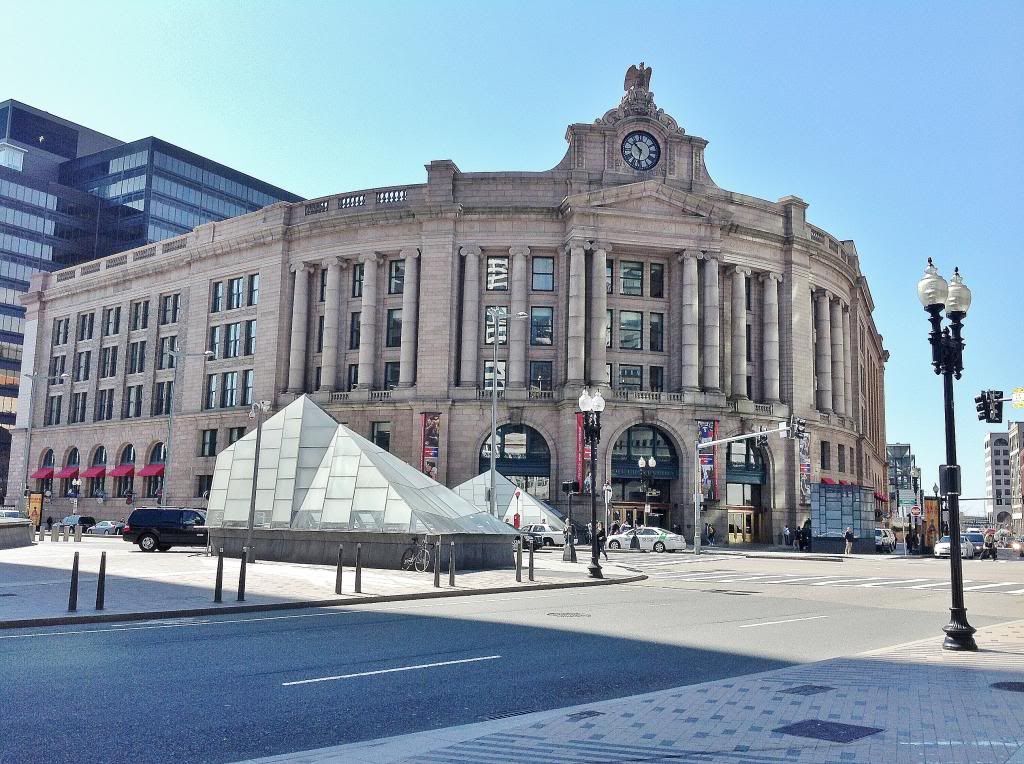 I identified
the cross street leading to the Hynes Convention Center, and once safely on the
other side, paused to take some pictures of the obviously old, historic
buildings, which had been nicely restored.
I identified
the cross street leading to the Hynes Convention Center, and once safely on the
other side, paused to take some pictures of the obviously old, historic
buildings, which had been nicely restored.

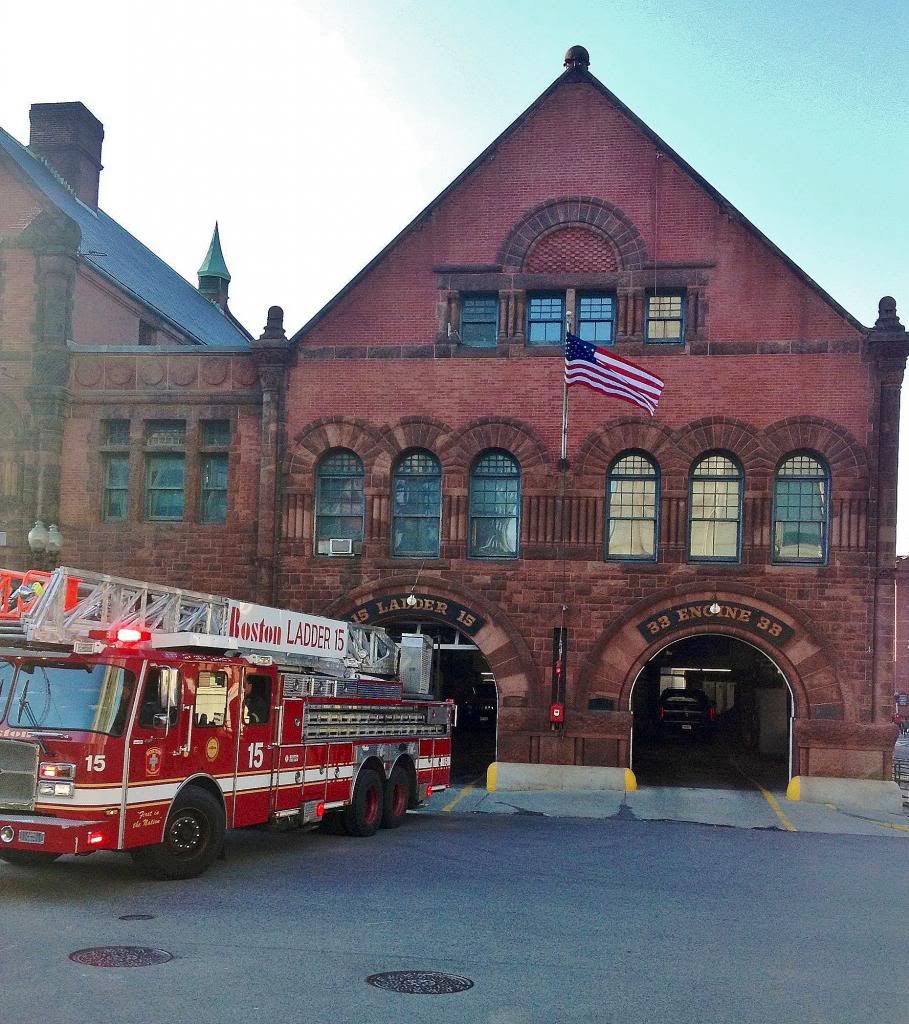 Suddenly I heard a fire alarm, and the garage doors of a fire station
began to open. Two large, hook and
ladder fire trucks pulled out with lights and sirens, with firemen in full
attire riding on the back, obviously en route to an emergency. In retrospect, I feel a bit guilty that I did
not give a second thought of gratitude for those who serve and protect…
Suddenly I heard a fire alarm, and the garage doors of a fire station
began to open. Two large, hook and
ladder fire trucks pulled out with lights and sirens, with firemen in full
attire riding on the back, obviously en route to an emergency. In retrospect, I feel a bit guilty that I did
not give a second thought of gratitude for those who serve and protect…


Uncertain of exactly where to go, I joined in the steady stream of runners going up the escalators in the convention center, and then saw a sign directing me to the bib and packet pickup. My excitement built, as signs everywhere welcomed the world – and ME to Boston! I found the line leading to my assigned bib number and did my best to patiently wait my turn,

watching the excitement of each person ahead of me. Finally, after showing my picture ID, I was handed the Holy Grail, of Golden Tickets - my runner’s packet and bib! I suppose that if this were not your first time running Boston, it might not be that big of a deal, but I had to pinch myself to make sure I was not dreaming!
 After trying
on my shirt and taking more pictures, I began walking through the expo,
determined to see all of the over 200 exhibits, taking in over two huge exhibit
halls. I found the Nordic Track booth,
and talked with the employees there, who know my neighbor. It was nice to make a connection in such a
big city. I found the Adidas official
clothing area, and started by trying on the official running jacket. I was willing to shell out $100 for this
prized piece of clothing, because I did not know if I would ever return again,
and there would only be one “first time.”
I realized that I would need a size medium, but it became apparent that
I was too late, as that size was sold out.
I thought about buying a large, but decided to wait, and check at the
other Adidas booth on the other side of the expo. I asked there if they had any medium jackets
left, and they said they had just sold the last one. Just then, a runner came up and asked if he
could exchange a medium for a large –
After trying
on my shirt and taking more pictures, I began walking through the expo,
determined to see all of the over 200 exhibits, taking in over two huge exhibit
halls. I found the Nordic Track booth,
and talked with the employees there, who know my neighbor. It was nice to make a connection in such a
big city. I found the Adidas official
clothing area, and started by trying on the official running jacket. I was willing to shell out $100 for this
prized piece of clothing, because I did not know if I would ever return again,
and there would only be one “first time.”
I realized that I would need a size medium, but it became apparent that
I was too late, as that size was sold out.
I thought about buying a large, but decided to wait, and check at the
other Adidas booth on the other side of the expo. I asked there if they had any medium jackets
left, and they said they had just sold the last one. Just then, a runner came up and asked if he
could exchange a medium for a large – 
 I made my way back to the “T”
subway, and took the Red Line southbound past Ashmont to Mattapan Station.
I made my way back to the “T”
subway, and took the Red Line southbound past Ashmont to Mattapan Station. 
 After
chatting with my gracious host for a while, I prepared my pre-race breakfast, retired to my room, opened up my runner’s packet,
pinned my bib to my shirt, and laid out my clothing for race day. I
checked and double-checked my race drop bag, making sure I had everything I
would need. I included my subway pass,
but did not pack my wallet or cell phone, as I did not want to risk losing
either of these. I did include an older de-activated cell phone to take a few
pictures on race morning, which I would put in my drop bag before starting the
race.
After
chatting with my gracious host for a while, I prepared my pre-race breakfast, retired to my room, opened up my runner’s packet,
pinned my bib to my shirt, and laid out my clothing for race day. I
checked and double-checked my race drop bag, making sure I had everything I
would need. I included my subway pass,
but did not pack my wallet or cell phone, as I did not want to risk losing
either of these. I did include an older de-activated cell phone to take a few
pictures on race morning, which I would put in my drop bag before starting the
race.
 Although it was a number of hours before
start time, I nervously nibbled on a bagel with cream cheese to pass the time
on the ride into the city. Even with the
transfer to the subway, I made it to the bus loading area about 20 minutes
ahead of my assigned boarding time.
Although it was a number of hours before
start time, I nervously nibbled on a bagel with cream cheese to pass the time
on the ride into the city. Even with the
transfer to the subway, I made it to the bus loading area about 20 minutes
ahead of my assigned boarding time. I walked along
the long line of double and triple-parked buses along Tremont Street, which seemed
to extend for many blocks. By now the sky was beginning to lighten above the
leafless trees on the Boston Common. As
I neared the front of the sea of yellow, one of countless volunteers waved me
into a bus, strategically loading each one to capacity.
I walked along
the long line of double and triple-parked buses along Tremont Street, which seemed
to extend for many blocks. By now the sky was beginning to lighten above the
leafless trees on the Boston Common. As
I neared the front of the sea of yellow, one of countless volunteers waved me
into a bus, strategically loading each one to capacity. 
When the bus finally came to a stop and the air brakes were set with a "psssssshhhhff," my eyes were no doubt, as big as saucers as I stepped onto the street and saw hundreds of volunteers and thousands of runners, the huge tents,

 The
athletes’ village covered an area the size of at least two football fields,
included a number of huge white tents over tables of food and drinks, and had
blue porta-potties lining a majority of the perimeter. Small vehicles were hauling off trash and
debris from the first wave of runners, while other vehicles were bringing in
more food and supplies for the second wave.
It was a logistical marvel of organized chaos, as there was adequate
room, food and supplies for over 10,000 athletes at a time!
The
athletes’ village covered an area the size of at least two football fields,
included a number of huge white tents over tables of food and drinks, and had
blue porta-potties lining a majority of the perimeter. Small vehicles were hauling off trash and
debris from the first wave of runners, while other vehicles were bringing in
more food and supplies for the second wave.
It was a logistical marvel of organized chaos, as there was adequate
room, food and supplies for over 10,000 athletes at a time! I walked
through the tables and selected a bagel, banana and some hot cocoa to add to my
breakfast, and then found a spot on the damp grass against the fence to relax
and eat, using some scrap cardboard to insulate myself from the cool
ground. The weather seemed perfect for
running, cool with no wind, and the sun peeking over the trees felt good on my
face.
I walked
through the tables and selected a bagel, banana and some hot cocoa to add to my
breakfast, and then found a spot on the damp grass against the fence to relax
and eat, using some scrap cardboard to insulate myself from the cool
ground. The weather seemed perfect for
running, cool with no wind, and the sun peeking over the trees felt good on my
face. 


When I saw these missionaries showing their community support, cheering the runners on, I made it a point to high-five each one of them, thinking about my missionaries out in the field too! As the miles gradually ticked away through each of the small towns, such as Ashland, Framingham and Natick, I was impressed with the incredible spirit of volunteerism, service and support of people lining the entire route.

I could have literally given high fives the entire distance, if I had wanted! There were banners and signs of encouragement all along the way. I even saw a banner for the Big Cottonwood Marathon later this year in Utah! Aid stations were plentiful, with an official one at every mile, and many impromptu food and drink stands set up by families along the way – some with very interesting and creative offerings! As the race and day progressed, the roadside celebrations seemed to get more pronounced – front yard barbecues, picnics, family reunions, and some resembling frat house parties!